
Vedic Rishis(वैदिक ऋषि)
Vedic Rishis: The Ancient Seers of Divine Knowledge
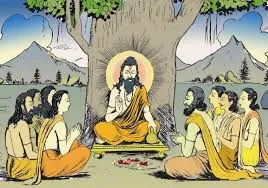
The Vedic Rishis were enlightened sages and seers of ancient India who played a crucial role in the composition, preservation, and transmission of the Vedas, the oldest and most sacred scriptures of Hinduism. These rishis were believed to have received divine revelations through deep meditation and tapas (austerity), which they then expressed in the form of hymns, mantras, and philosophical discourses. Their wisdom laid the foundation for Hindu spiritual traditions, philosophy, and ethical values, shaping the very essence of Vedic civilization.
1. Meaning and Significance of "Rishi"
The Sanskrit word "Rishi" is derived from the root "ṛṣ", which means "to see" or "to perceive." This indicates that a rishi was not merely a scholar but a seer of truth, someone who had attained a heightened state of consciousness and directly experienced the cosmic reality. The Rigveda, the oldest of the Vedas, refers to the rishis as "mantradrashta", meaning "seers of mantras"—not composers but recipients of divine wisdom.
Rishis were regarded as the conduits between the divine and human realms, their insights forming the basis of Vedic rituals, spiritual practices, and societal norms. Their contributions were passed down through generations via an unbroken oral tradition known as Shruti (that which is heard).
2. Prominent Vedic Rishis and Their Contributions
There were numerous rishis associated with the revelation of Vedic hymns. Some of the most revered among them include:
a. The Saptarishis (Seven Great Sages)
According to Vedic and Puranic traditions, the Saptarishis were the seven most enlightened sages entrusted with preserving dharma (righteousness) and imparting divine knowledge. They are:
Vashishtha – A great sage and spiritual advisor to kings, known for composing hymns in the Rigveda and associated with deep wisdom and yogic practices.
Vishwamitra – A warrior-turned-sage who attained the status of a Brahmarishi through intense penance. He is credited with composing the Gayatri Mantra, one of the most powerful Vedic mantras.
Atri – The author of several hymns in the Rigveda and the founder of the Atri lineage (Atreya gotra).
Bharadvaja – A great scholar and seer associated with Ayurveda and military sciences. His hymns appear in the Rigveda.
Gautama – The progenitor of the Gautama Gotra and a philosopher credited with significant contributions to logic and ethics.
Jamadagni – A master of Vedic rituals and the father of Parashurama, the sixth incarnation of Vishnu.
Kashyapa – A key figure in the creation of the universe, considered the father of many celestial beings, demons, and humans in Hindu mythology.
b. Other Notable Rishis
Agastya – A revered rishi who played a crucial role in spreading Vedic knowledge to southern India. He is credited with several hymns in the Rigveda.
Bhrigu – Considered the father of Vedic astrology (Jyotisha) and compiler of the Bhrigu Samhita, an ancient astrological treatise.
Angiras – An early Vedic sage who contributed to the Rigveda and was known for his profound spiritual insights.
3. Role of Rishis in Vedic Society
The Vedic rishis were not merely ascetics or hermits; they played multiple roles in society as:
Spiritual Guides – They provided ethical and philosophical teachings that shaped the moral fabric of ancient India.
Composers of Hymns – Their compositions in the Vedas covered everything from cosmology and metaphysics to everyday life.
Scientists and Healers – Many rishis contributed to Ayurveda, astronomy, and other sciences.
Gurus of Kings – Rishis like Vashishtha and Vishwamitra were royal preceptors, guiding kings in governance and dharma.
4. The Rishis and the Four Vedas
Each of the four Vedas—Rigveda, Yajurveda, Samaveda, and Atharvaveda—is attributed to different groups of rishis.
Rigveda – Composed of hymns mostly revealed to rishis like Vishwamitra, Vashishtha, and Agastya.
Yajurveda – Focuses on rituals and was enriched by rishis like Yajnavalkya.
Samaveda – Musical and devotional hymns associated with sages like Jaimini.
Atharvaveda – Contains knowledge about medicine, magic, and practical life, credited to sages like Angiras and Kashyapa.
5. The Legacy of the Vedic Rishis
The teachings of the Vedic rishis remain relevant even today, forming the bedrock of Hindu spirituality, yoga, and meditation. Their wisdom continues to inspire seekers in their pursuit of self-realization and enlightenment.
Even modern scientific studies recognize the deep insights contained in the Vedic hymns—whether in cosmology, mathematics, or psychology—highlighting the rishis' profound understanding of the universe.
Conclusion
The Vedic Rishis were not just historical figures but timeless luminaries whose wisdom transcends eras. They were the architects of India's spiritual heritage, shaping its culture, traditions, and worldview. Their teachings continue to guide humanity toward a higher consciousness, making them an eternal source of inspiration for spiritual aspirants and scholars alike.